








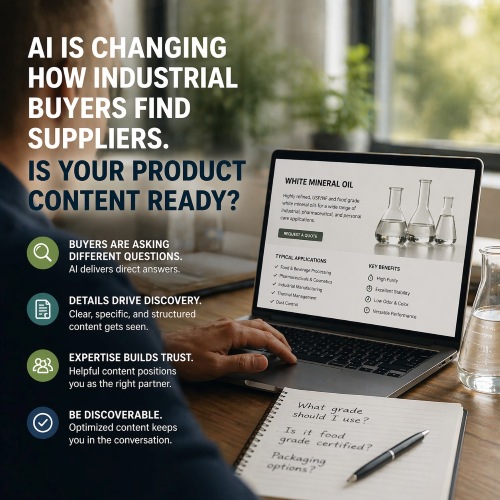
AI Is Changing How Industrial Buyers Find Suppliers—Is Your Product Content Ready?
For years, industrial procurement followed a predictable path.
- ✔ Search Google
- ✔ Compare suppliers
- ✔ Request a quote
But that process is changing—fast.
Today, engineers, procurement teams, and operations leaders are increasingly turning to AI-powered tools like ChatGPT and other conversational search platforms to find answers, evaluate products, and identify suppliers.
And that shift is redefining how companies like yours get discovered.
From Search Engines to Answer Engines
Traditional SEO focused on ranking pages.
AI changes the game entirely.
Instead of returning a list of links, AI tools deliver direct answers—often pulling from multiple sources and summarizing them in seconds.
That means:
- Buyers may never visit your website first
- Your content must be clear enough to be quoted
- Technical accuracy matters more than ever
- Depth and structure influence whether you show up at all
If your product content isn’t built for this environment, you’re invisible.
What AI Looks for in Industrial Content
AI systems prioritize content that is:
- Structured and scannable
- Technically accurate and specific
- Clear in use-case applications
- Consistent across pages and formats
For products like white mineral oil, that means going beyond general descriptions and answering real questions like:
- What industries use this grade of oil?
- What specifications matter most?
- How is it stored, handled, or transported?
- What differentiates one supplier from another?
The more directly your content answers these questions, the more likely it is to be surfaced.
Why Generic Product Pages No Longer Work
Many industrial websites still rely on:
- Short product blurbs
- Minimal technical detail
- PDF-heavy documentation
- Inconsistent terminology
That approach limits visibility in AI-driven discovery.
AI doesn’t interpret vague content well—it prioritizes clarity and context.
In other words:
If your content isn’t specific, it won’t be selected.
The Shift Toward “Answer-Based” Content
The companies gaining visibility today are building content designed to answer—not just describe.
This includes:
- Application-focused blogs
- Detailed product pages with structured data
- Use-case breakdowns by industry
- Packaging, logistics, and handling clarity
- Supporting technical content that reinforces expertise
Each piece acts as a signal—to both buyers and AI platforms—that your company understands the product and its applications.
Where White Mineral Oil Fits In
White mineral oil is used across a wide range of industries, from food-grade applications to industrial processes and emerging technologies like thermal management.
That diversity creates an opportunity—but also a challenge.
If your content doesn’t clearly define:
- Grades and specifications
- Use cases by industry
- Compliance considerations
- Packaging and delivery options
…then buyers—and AI tools—will look elsewhere for answers.
Preparing for the Next Phase of Discovery
AI isn’t replacing search—it’s reshaping it.
And the companies that adapt their content strategy now will be the ones that remain visible as buying behavior continues to evolve.
That means:
- Writing content that answers real questions
- Structuring information clearly
- Maintaining consistency across all product-related pages
- Investing in thought leadership that connects product to application
How STEOIL Is Thinking About This Shift
At STEOIL, we recognize that product quality is only part of the equation.
How that product is communicated—online, in search, and in AI-driven environments—is becoming just as important.
That’s why we continue to expand our content to better support:
- Industry-specific applications
- Technical clarity
- Transparent product information
- Consistent, accessible resources for customers
Final Thought
The way buyers find suppliers is evolving.
The question isn’t whether AI will influence your industry—it already is.
The question is whether your content is ready to be part of that conversation.
For years, industrial procurement followed a predictable path.
- ✔ Search Google
- ✔ Compare suppliers
- ✔ Request a quote
But that process is changing—fast.
Today, engineers, procurement teams, and operations leaders are increasingly turning to AI-powered tools like ChatGPT and other conversational search platforms to find answers, evaluate products, and identify suppliers.
And that shift is redefining how companies like yours get discovered.
From Search Engines to Answer Engines
Traditional SEO focused on ranking pages.
AI changes the game entirely.
Instead of returning a list of links, AI tools deliver direct answers—often pulling from multiple sources and summarizing them in seconds.
That means:
- Buyers may never visit your website first
- Your content must be clear enough to be quoted
- Technical accuracy matters more than ever
- Depth and structure influence whether you show up at all
If your product content isn’t built for this environment, you’re invisible.
What AI Looks for in Industrial Content
AI systems prioritize content that is:
- Structured and scannable
- Technically accurate and specific
- Clear in use-case applications
- Consistent across pages and formats
For products like white mineral oil, that means going beyond general descriptions and answering real questions like:
- What industries use this grade of oil?
- What specifications matter most?
- How is it stored, handled, or transported?
- What differentiates one supplier from another?
The more directly your content answers these questions, the more likely it is to be surfaced.
Why Generic Product Pages No Longer Work
Many industrial websites still rely on:
- Short product blurbs
- Minimal technical detail
- PDF-heavy documentation
- Inconsistent terminology
That approach limits visibility in AI-driven discovery.
AI doesn’t interpret vague content well—it prioritizes clarity and context.
In other words:
If your content isn’t specific, it won’t be selected.
The Shift Toward “Answer-Based” Content
The companies gaining visibility today are building content designed to answer—not just describe.
This includes:
- Application-focused blogs
- Detailed product pages with structured data
- Use-case breakdowns by industry
- Packaging, logistics, and handling clarity
- Supporting technical content that reinforces expertise
Each piece acts as a signal—to both buyers and AI platforms—that your company understands the product and its applications.
Where White Mineral Oil Fits In
White mineral oil is used across a wide range of industries, from food-grade applications to industrial processes and emerging technologies like thermal management.
That diversity creates an opportunity—but also a challenge.
If your content doesn’t clearly define:
- Grades and specifications
- Use cases by industry
- Compliance considerations
- Packaging and delivery options
…then buyers—and AI tools—will look elsewhere for answers.
Preparing for the Next Phase of Discovery
AI isn’t replacing search—it’s reshaping it.
And the companies that adapt their content strategy now will be the ones that remain visible as buying behavior continues to evolve.
That means:
- Writing content that answers real questions
- Structuring information clearly
- Maintaining consistency across all product-related pages
- Investing in thought leadership that connects product to application
How STEOIL Is Thinking About This Shift
At STEOIL, we recognize that product quality is only part of the equation.
How that product is communicated—online, in search, and in AI-driven environments—is becoming just as important.
That’s why we continue to expand our content to better support:
- Industry-specific applications
- Technical clarity
- Transparent product information
- Consistent, accessible resources for customers
Final Thought
The way buyers find suppliers is evolving.
The question isn’t whether AI will influence your industry—it already is.
The question is whether your content is ready to be part of that conversation.


(800) 967-1931 x 23





Your Clear Source for White Mineral Oils.